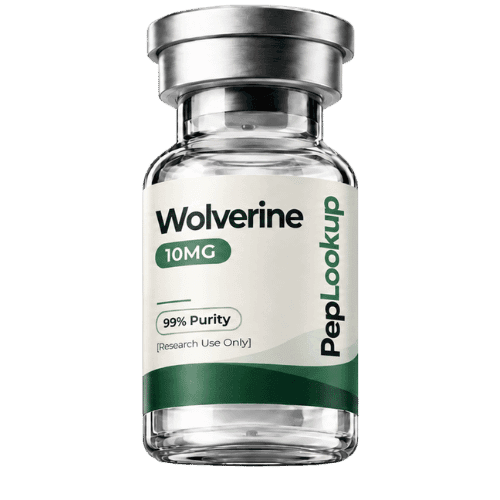
Wolverine is a premixed research blend of BPC-157 and TB-500 supplied in a single vial. It targets tissue repair and recovery research, combining localised angiogenic action with systemic actin regulation without requiring two separate reconstitutions.
Wolverine is a premixed research blend of BPC-157 and TB-500 supplied in a single vial. It targets tissue repair and recovery research, combining localised angiogenic action with systemic actin regulation without requiring two separate reconstitutions.
Tissue Repair
Recovery Support
Injury Research
What the research reports
Reported benefits of Wolverine
Outcomes described across the published Wolverine literature and ongoing study. Read each as research context rather than a promised personal result.
01
Single vial blend convenience
Both peptides arrive premixed, removing the need to reconstitute, measure and track two separate vials across a protocol. Reported in research settings.
02
Combined repair mechanisms
Pairs localised angiogenic action with systemic actin regulation, the rationale originally used to justify stacking the two peptides. A 2026 rat tendon study testing this exact combination found no added benefit over either peptide alone, so this rationale remains theoretical rather than demonstrated. Reported in research settings.
03
Consistent component ratio
A fixed ratio means each dose delivers the same proportion of both peptides, which makes a protocol easier to reproduce. Reported in research settings.
04
Recovery research application
Widely used in athletic recovery contexts for tendon, muscle and joint research, though the blend has no clinical trial. Reported in research settings.
05
Component level study support
Both peptides carry their own preclinical record. A 2026 rat study has since tested the combination directly and found no added benefit over either peptide alone, so the vial's own evidence does not yet support an advantage over using either peptide individually. Reported in research settings.
Clinical evidence
Clinical evidence for Wolverine
The published Wolverine record, labeled by strength so you can see what is settled and what is still emerging.
Combination tendon study, 2026
A 2026 rat study directly tested BPC-157 and TB-500 together on Achilles tendon healing. The combination did not outperform either peptide alone on biomechanical or histological measures, and the authors concluded it conferred no additional benefit over single-peptide treatment. This is animal data; no human clinical trial of the combination exists.
A 2021 case series reported significant improvement in 87.5 percent of 17 knee pain patients given intra-articular BPC 157 across one year of follow up. Reported in the cited paper.
A 2016 review of thymosin beta-4 reported faster dermal repair in chronic wounds, the component evidence behind the TB-500 half of this vial. Reported in the cited paper.
Added in GLOW style blends, extending the vial toward collagen and elastin signalling as well.
KPV peptide
Added in KLOW style blends to bring inflammatory signalling into the same repair protocol.
Ipamorelin
No known negative interaction. The growth hormone axis sits apart from both repair mechanisms.
Semaglutide
No known negative interaction. Metabolic and tissue repair pathways do not meaningfully overlap.
Questions
Frequently asked questions.
What is the Wolverine peptide stack?
Wolverine is a premixed research blend of BPC-157 and TB-500 in a single vial, combining localized angiogenic signaling with systemic actin regulation, without requiring two separate reconstitutions.
What are the research benefits of the Wolverine stack?
Each component peptide carries its own preclinical research record in tissue repair contexts. A 2026 rat study testing the combination directly found no added benefit over either peptide alone, so the main documented advantage of this specific blend is dosing convenience rather than proven synergy.
How does the Wolverine stack work?
BPC-157 is studied for localized angiogenic and tissue-protective signaling, while TB-500 (thymosin beta-4) is studied for actin regulation supporting cell migration in wound repair. They are combined here for convenience; current combination research does not show one pathway amplifying the other.
Is the Wolverine stack for research use only?
Yes. This product is sold for laboratory and research purposes only. PepLookup does not provide dosing or administration guidance; consult the primary literature cited in the Evidence section above.
What should I look for before buying the Wolverine stack?
Check for a third-party Certificate of Analysis (COA) confirming the actual ratio and purity of both peptides in the vial, since a premix removes your ability to verify each component independently, and compare documentation and pricing across the suppliers listed on this page.